

Next Poker (fast-fold): how it works and who it fits
Updated: August 2026
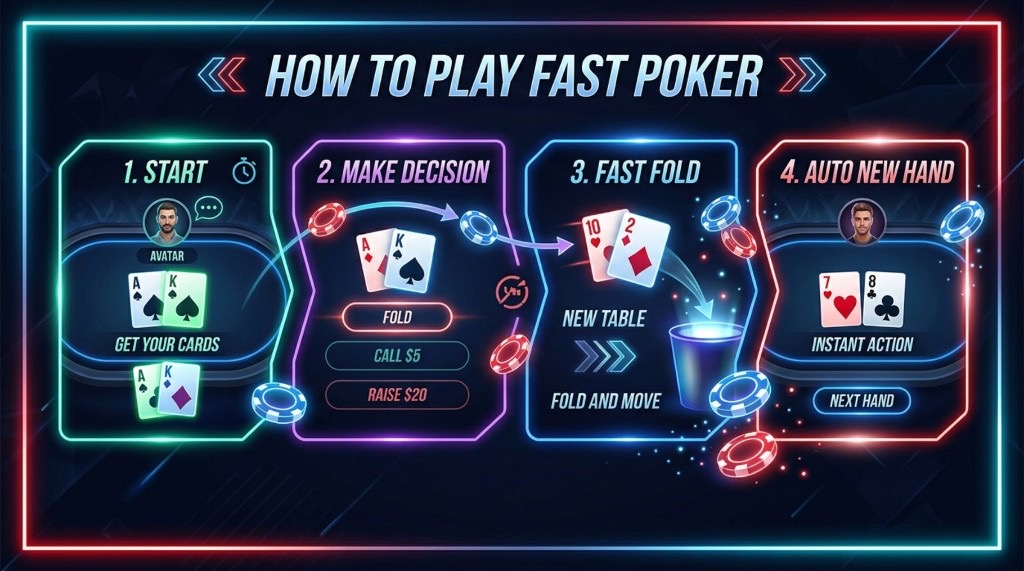
Next Poker — often labeled Next! in the client — is a fast-fold cash format. You buy in at a stake, join a shared pool, and when you fold the software usually seats you at a fresh table instead of making you wait out the hand. Same hold'em rules; different rhythm. You see more spots per hour, which helps repetition if you review your play, and hurts you fast if you click on autopilot.
We run this site as an independent guide, not as Stake or any operator. We don't promise profit. Poker has variance, pools change, and speed makes small leaks add up quickly. What we can do is explain the format honestly, point to practical defaults, and keep responsible-play limits in the same conversation as strategy.
How we update: we re-check the Stake lobby flow, visible labels, and limits language when Stake ships client changes. Strategy notes stay general — they depend on your stake, stack depth, and who is in the pool. Last checked: August 2026.
Explore the guide: step-by-step how to play · rules vs classic cash · fast-fold strategy and common leaks · bankroll and session limits · FAQ for quick checks.
Why players pick fast-fold over ring cash
More hands, less waiting
Classic online cash has dead air: you fold, you watch, you wait. Fast-fold compresses that. Fold and you're usually offered another hand immediately. If you're trying to build preflop discipline or see more similar spots, that repetition can help — but only if you keep thinking and review afterward.
The real opponent is pace
Speed saves time; it also tempts your brain into shortcuts. Autopilot opens, rushed bluffs, and "one more orbit" sessions show up faster here than at a single ring table. Pools on Stake and similar sites aren't static either — as traffic grows, baseline strategy matters more than table-image tricks.
Stake Next Poker in practice
Next Poker currently lives inside Stake's poker lobby (verify in your client — product lines shift by region). Treat it as a living pool: stakes, traffic, and population tendencies change. A format that felt soft six months ago can feel standard today. Check the lobby before you assume anything about game quality.
How Next Poker Works (Fast-Fold Mechanics)
The pool: you're playing the format, not one table
Ring cash lets you pick a table and build reads over dozens of hands. Next Poker puts you in a stake-level pool: real blinds, real stacks, but the lineup rotates because everyone keeps folding into new seats. Population reads replace long personal histories.
Instant re-seat after a fold
After you fold, the client moves you on instead of making you sweat out the rest of the hand. Some builds even offer fast-fold before action reaches you. Less waiting; fewer showdowns. You'll infer more from ranges and pool tendencies than from watching every river.
What stays the same vs classic cash
Hand rankings, betting streets, blinds, and core rules remain the same. What changes is time structure and information flow. If you want a step-by-step walkthrough, start with How to play Next Poker. For terminology and implications, see Rules and differences.
Next Poker vs Classic Cash Games (Quick Comparison)
People often ask “Next Poker vs classic cash—which is better?” The honest answer is: better for what goal? Fast-fold is optimized for volume and repetition. Classic cash is optimized for table dynamics, reads, and deep exploitation. Here’s a practical comparison you can use before choosing your main format.
| Factor | Next Poker / Fast-Fold | Classic Cash Games |
|---|---|---|
| Hands per hour | High: constant stream, little waiting | Medium: more downtime between hands |
| Decision cadence | Fast: frequent preflop spots, quick transitions | Slower: more time to breathe and observe |
| Reading opponents | More population reads, fewer long histories | More table dynamics, stronger individual exploits |
| Best for learning | Great for repetition if you review + keep discipline | Great for fundamentals and slower decision-making |
| Tilt & fatigue risk | Higher: many decisions amplify emotion quickly | Lower-to-medium: more natural pauses |
| Variance & bankroll demands | Can feel higher due to volume; bankroll discipline matters | More “paced” variance; still requires proper bankroll |
| Best fit | Busy players, grinders, structured learners | Exploit-focused players, deep table selection |
One more practical difference: in fast-fold, “a small leak” doesn’t stay small for long. If you routinely make -0.5bb mistakes in common spots, you’ll simply make that mistake more times per hour. That’s why a solid fast fold strategy is more about reliable defaults than fancy lines.
Who Next Poker Is For — and Who Should Avoid It
Good fit: disciplined grinders and structured learners
Next Poker tends to suit players who already have baseline fundamentals and want to increase volume without increasing the number of tables. It can be a strong choice if you:
- can stick to a preflop plan without “experimenting” every other hand;
- review hands (even briefly) and adjust based on evidence, not vibes;
- have stable emotional control and you can end sessions on schedule;
- want efficient practice in repeating decision types.
Caution: brand-new players and tilt-prone sessions
Fast-fold can be genuinely dangerous for beginners—not because the rules are harder, but because the speed makes it easier to build bad habits. If you’re still learning what a standard 3-bet range looks like, or you often chase losses, start with classic cash (or shorter sessions) and use Next Poker later as a training tool. The format rewards those who can slow down mentally even while the game speeds up.
A simple self-check before you play
- Bankroll: do you have a stake that you can comfortably lose without stress?
- Time: do you have a hard stop and a break plan?
- Mood: are you calm, or already trying to “fix” something?
- Process: do you know your default opens, 3-bets, and fold rules?
If any answer is “no,” the best strategy is not a new line—it’s a smaller stake, a shorter session, or a day off. For practical guardrails, see Responsible Gambling.
Beginner Fast Fold Strategy (Practical Foundations)
Preflop: tighten first, then expand with control
The biggest early win in fast fold strategy is removing marginal noise. In fast-fold, “close” preflop spots appear constantly—weak offsuit broadways, dominated aces, loose calls out of position. The disciplined approach is to tighten your baseline until you can execute it cleanly, then widen with a clear reason (position, opponent tendency, rake context if known).
Two simple rules that help beginners:
- Prefer raising over calling when you choose to play a hand, especially in late position.
- Avoid out-of-position calling with hands that can’t realize equity well.
For the full flow (lobby → pool → hands → review), see how to play Next Poker.
Postflop: simplify lines, value-first, fewer hero bluffs
Fast-fold rewards players who can make many good-enough decisions, not players who hunt for brilliant bluffs while tired. For most beginners, the profitable default is:
- Value bet clearly when you’re ahead and can get called by worse.
- Choose simpler sizings you can repeat consistently.
- Reduce thin bluff-catching unless you can name the bluffs you beat.
Because you see fewer long histories, focus on position, texture, and population tendencies. The “reading” skill becomes: “What does this line represent for most players at this stake?” more than “What does this one villain always do?”
Session control: the edge most players ignore
In fast-fold, responsible play is not an afterthought—it’s part of the strategy. Decide your limits before you click play:
- Time cap: e.g., 30–60 minutes, then a forced break.
- Stop-loss: a predefined amount you can lose without chasing.
- Quality rule: if you notice autopilot (rushing, clicking), end the session.
We cover practical leaks and session control in fast-fold strategy and the safety layer in responsible gambling.
What You’ll Find on This Site
NextPoker.org is built as a practical map. If you’re new, start with mechanics. If you already play, jump to strategy and session control. Here are the key pages:
Ready to Play Next Poker?
Fast-fold poker is a volume tool. Treat it like one: pick a stake you can handle, set time limits, and protect your decision quality.
If you want to play, do it intentionally. If you want to learn, do it systematically. And if you’re not sure which format fits you, start with the comparison above and our FAQ.
Transparency & Responsible Gambling
Independent resource: NextPoker.org is not an operator and not a get-rich-quick promise. We publish educational content for adults (18+) and focus on safe, realistic decision-making.
Affiliate disclosure: We may earn a commission if you use partner links. The link above goes through an internal redirect page (partner redirect (partner redirect)) so the partner URL isn’t exposed directly in the site navigation.
Responsible play: If poker stops being entertainment and starts feeling like chasing, take a break and use tools like deposit limits, timeouts, or self-exclusion where available. Start with our Responsible Gambling page.
Related deep-dive articles
If you want long-form, independent guides on specific decisions (which format to start with, how bankroll math shifts, how to navigate the Stake lobby), open the Articles hub or jump straight in:
- Fast-fold vs regular cash for beginners — readiness checklist
- Bankroll management: fast-fold vs regular cash — why same rules quietly fail
- Next Poker / Stake for Canada — Ontario notes, geo checks, and safer-play lines
- Next Poker / Stake for Brazil — PIX notes, geo checks, and what we won't claim
- How to find Next Poker in the Stake lobby (step-by-step)
- Stake Next Poker: formats, stakes and pre-play checklist
- What is fast-fold poker? Plain-English explainer
- What is Next Poker on Stake? How the format actually works
- Switching from regular cash to fast-fold — what changes first
- Five common fast-fold spots explained (with reasoning)
- Next Poker not showing on Stake? Geo & lobby checks (18+)
- Fast-fold, Zoom & Next Poker — what the terms mean
- Tilt in fast-fold vs regular cash — why speed changes it
- Preflop defaults for Next Poker — simple ranges with examples
- Responsible gambling on Stake Next Poker — tools & limits (18+)
Read Also
- How to play Next Poker (step-by-step)
- Next Poker vs classic cash: rules and differences
- Fast-fold strategy: defaults and common leaks
- Bankroll and session limits for fast-fold poker
- Next Poker FAQ: quick answers
Bookmark the pages you actually use — how to play, strategy, limits — and come back after a few sessions with notes on what leaked.