
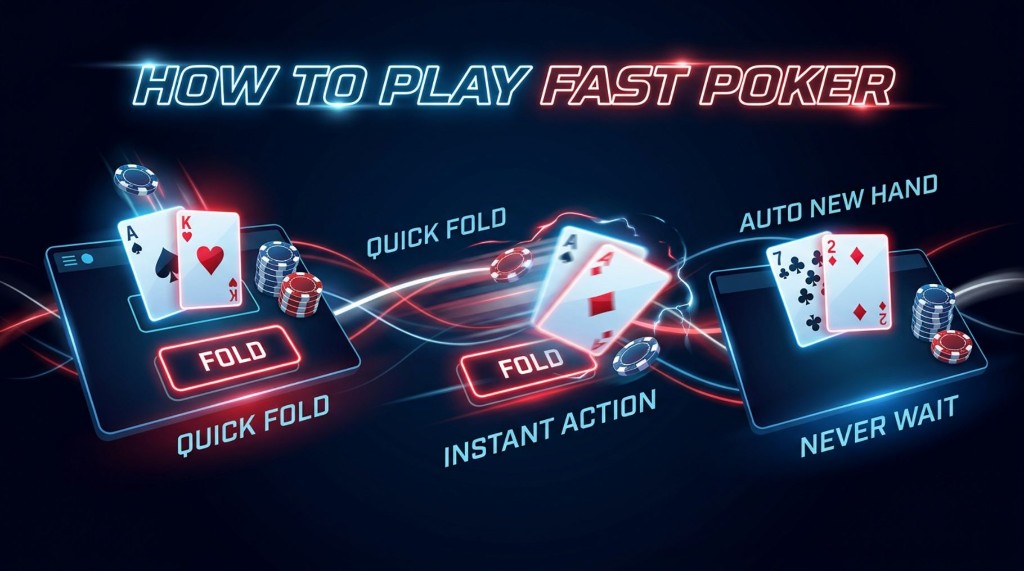
How to play Next Poker from lobby to session review
Updated: August 2026
Same hold'em rules as ring cash. Different delivery: more hands per hour, thinner table history, less downtime between pots. That helps if you already have a plan. It hurts if a short win makes you move up, or a short loss makes you chase.
No guarantees here — variance stays. What you can control: stake vs bankroll, session length, one-table focus while learning, and a repeatable preflop/postflop map. For format comparison, read rules and differences. For range work, use fast-fold strategy. If discipline is the weak point, keep responsible gambling open as part of the plan, not a footnote.
Quick orientation: what fast-fold rewards and punishes
Q.1. What actually changes compared with a normal cash table
The cards, hand rankings, blind structure, and core rules stay the same. What changes is the environment around your decisions. In a standard cash game you often remain with the same lineup for a meaningful stretch, build reads, and pick specific seats or targets. In Next Poker, the pool rotates constantly. You still benefit from general population tendencies, but you get fewer long, table-specific reads. That means your default ranges, position awareness, and emotional stability matter more than table image tricks.
The practical consequence is simple: you should not build your whole approach around fancy exploit ideas unless you have reliable evidence. The baseline is more important here than your most creative line. If you have ever thought, "I will just outplay people postflop every hand," fast-fold is a useful reality check. Volume exposes weak fundamentals quickly.
Q.2. Who should start carefully or avoid the format for now
If you are brand new to no-limit hold'em, fast-fold may be the wrong first environment. There is less breathing room, fewer obvious pauses, and more temptation to click through marginal spots. A beginner often learns more from a slower table where each orbit gives time to think about position, stack depth, and why a decision was made. A player recovering from tilt problems should also be cautious. Speed can make loss-chasing feel "small" because each individual hand seems minor, but the total exposure rises quickly.
A better starting point is one table, low stakes, short sessions, and a strict stop. If that already feels rushed, step back. There is nothing weak about choosing a slower game or a lower limit. It is usually the stronger long-term decision.
Q.3. What you should decide before opening the lobby
Before the first hand, define four things: stake, table count, stop-loss, and stop-time. Do not wait until you are in a hand to answer those questions. A player who decides in the moment usually decides emotionally. A simple rule can be: one table only, 45 minutes maximum, stop after two buy-ins lost, and no limit changes during the session. If you are experienced and properly bankrolled, your numbers can differ, but the structure should stay.
That discipline matters because the format keeps offering a next hand, and then another one. The software is built for continuity. Your job is to create boundaries around it. The page at responsible gambling explains why time control is not optional in fast games.
Bankroll, boundaries, and basic setup
B.1. Choose a stake that survives variance, not a stake that flatters your ego
Fast-fold creates more decisions per hour, so short-term swings can feel sharper even when you are playing well. Because of that, bankroll discipline matters more, not less. For most recreational players, the safest practical rule is to play a stake where losing one or two buy-ins does not change your mood, your bills, or your behavior. If it does, the stake is too high. A player who is emotionally attached to each pot will either pass good spots out of fear or force bad spots out of frustration.
Keep poker funds separate from everyday money. If you deposit, treat the money as a fixed entertainment and learning budget. If the site offers a partner redirect page such as partner redirect (partner redirect), use it only after you have decided to play and after you have checked the operator terms for your jurisdiction, game availability, and limits. The redirect itself does not change the strategic reality: you still need a stake level your bankroll can support.
B.2. Default lobby checklist before you join the pool
Do not rush through the lobby just because the format is called fast. The lobby is where many good sessions are saved and many bad sessions begin. A short checklist reduces avoidable mistakes.
| Lobby item | Practical default | Why it matters |
|---|---|---|
| Stake | One level below your emotional comfort ceiling | Keeps a normal downswing from turning into panic play |
| Number of tables | Start with 1 | Lets you think through ranges and timing instead of clicking on autopilot |
| Session timer | 30-60 minutes | Prevents "just a few more hands" from becoming an uncontrolled grind |
| Stop-loss | 2 buy-ins for learning sessions, 3 for experienced regular play | Protects bankroll and emotional control |
| Auto top-up | On if you stay disciplined, off if reloading triggers tilt | Maintains stack depth, but only if you remain calm after losses |
| Notes or HUD substitute | Minimal and legal for the site | Helps identify obvious tendencies without slowing decisions too much |
| Distractions | Phone away, no extra video stream | Fast formats punish split attention more than slow ones |
B.3. Set a session goal you can control
"Win two buy-ins" is not a good session goal because it depends on cards, runouts, and opponents. Better goals are process-based: follow your opening ranges, avoid impulsive hero calls, mark three hands for review, and end the session on time. Good process can still produce a losing session. Bad process can still produce a winning one. The format becomes easier to manage when you judge yourself by decision quality first.
If you notice that your mood depends entirely on the cashier balance, stop and reset. That is usually the point where responsible gambling stops being theory and becomes a necessary boundary.
Step-by-step play: from lobby to the next hand
S.1. Enter the pool with a simple preflop map
Fast-fold rewards players who already know what they are trying to do before the cards arrive. You do not need a perfect solver tree to start. You do need a repeatable opening plan by position and a default response to common aggression. Think of it as a map, not a prison. You can adjust later, but you should begin with structure.
| Position or spot | Default preflop plan | Examples |
|---|---|---|
| UTG or early position | Open tighter, prefer strong broadways, big pairs, solid suited aces | Open AKo, AQs, TT+, often fold KJo, A9o, 76o |
| CO | Widen slightly if blinds look passive, but keep offsuit trash out | Open KQs, AJs, 88, T9s; avoid loose opens like Q7o |
| BTN | Open widest, but still value position over ego | Raise A5s, KTs, 66, J9s; fold hands that play badly postflop when unsure |
| Small blind first in | Use a disciplined raising range, avoid limp-click habits unless site pool clearly allows it | Raise AJo, KQo, 77+, many suited broadways; do not complete mindlessly |
| Facing an open in the blinds | Defend more versus late position, less versus early position | BB can continue with AJs, KQs, 99, some suited connectors; fold dominated offsuit hands |
| Facing a 3-bet | Continue with hands that retain equity; do not call just because you dislike folding | Continue with QQ, AK, sometimes AQs or JJ depending on positions and stack depth |
This is intentionally general. It is a safe start, not a final chart. When you are ready to refine ranges, use fast-fold strategy. Until then, consistency beats fake sophistication.
S.2. Practical preflop examples you can actually use
Example 1: AKo in middle position. In a normal stack configuration, opening is standard. If a tight early-position player 3-bets you, you usually continue, but the exact action depends on stack depth and population tendencies. The key mistake is not aggression; it is passivity without a reason. Folding AKo automatically because "it misses often" ignores how strong the hand is preflop.
Example 2: 77 on the button after folds. This is usually a comfortable open. If the big blind 3-bets large and is not out of line, calling only because you "might hit a set" is often too loose without the right stack conditions. In fast games, players leak money by overvaluing medium pairs against obvious strength.
Example 3: KQs in the cutoff facing a loose button 3-bet. KQs is often strong enough to continue, especially against late-position aggression, but you still need a plan for postflop. If you call, be prepared to fold some marginal one-pair situations on dangerous runouts. Calling without a plan is not a strategy.
Example 4: A5s in the button versus tight blinds. This can be a good open because the hand plays well in position, can make strong draws, and retains some wheel value. But if you are opening too many suited aces and then paying off too lightly postflop, your preflop discipline is not really disciplined.
S.3. Postflop in fast-fold: keep the line clear and honest
Postflop decisions should be simpler than many players make them. On dry boards in raised pots, your continuation bet often does best when it tells a consistent story and uses sensible sizing. On connected boards that hit the caller's range, a lower-frequency c-bet or a check becomes more reasonable. The exact frequencies depend on positions and pool tendencies, but the practical lesson is this: do not bluff just because the format is fast and you want momentum.
Suppose you open AQ on the button, the big blind calls, and the flop comes Q72 rainbow. This is often a value-heavy continuation spot. Bet because worse queens, sevens with backdoors, and pocket pairs may continue. Now compare that with opening AK, getting called in the big blind, and seeing 987 with two hearts. That board connects strongly with the defending range. A careless high-frequency c-bet burns money here.
Or take JJ on a flop of A84. Many players hate this board and either over-bluff to "represent the ace" or station too long because they cannot let an overpair go mentally. In reality, both extremes can be expensive. Often the strongest play is the least dramatic one: check back some frequency in position, or bet once for protection and then slow down when resistance makes sense.
S.4. Fold, reset, and do not carry the last hand into the next one
The most important technical skill in fast-fold may be emotional reset. Once you fold, the software offers another decision immediately. That sounds convenient, but it also means the previous hand can bleed into the next one before you have processed it. A bad beat does not justify a loose open with J8s from early position. Losing with kings does not make the next coin flip "due." Each hand is separate, even if your emotions try to connect them.
If you lose a meaningful pot, use one forced pause before clicking back in. Stand up. Take one note. Drink water. If you cannot do that because you are worried about missing volume, you are already prioritizing action over quality.
S.5. Use simple note-taking, not fantasy profiling
Because player rotation is fast, notes should be specific and rare. Good note: "3-bets button versus cutoff aggressively at 100bb." Bad note: "crazy player." Good note: "calls flop wide, folds turn to second barrel." Bad note: "fish." Specific behavior helps; vague labels mostly feed bias. In many pools, population reads matter more than personal history anyway, which is another reason the core framework at rules and differences is useful.
Table discipline, tilt control, and hand review
T.1. Common mistakes that look small but cost a lot
One common leak is opening too loose from early position because the next hand feels free. Another is defending blinds with dominated offsuit hands because folding repeatedly feels weak. A third is calling 3-bets out of position with hands that are attractive in theory but difficult in practice at your current level. A fourth is treating every small downswing as evidence that you should move stakes, change style, or force bluffs. Most losing stretches in this format are not caused by one huge punt. They are caused by many medium mistakes repeated quickly.
Another costly habit is session drift. You planned 40 minutes, but after 38 minutes you tell yourself the game is good and keep going. Then you lose a pot, extend again, and soon your decision quality drops. This is not a technical issue. It is a control issue.
T.2. Know when to stop, not only when to continue
End the session when any of the following becomes true: you are clicking faster than you are thinking, you want immediate revenge after a loss, you have started watching videos or chatting while playing, or you are ignoring your original stop-loss and time rules. Those are not minor warning signs. In a fast-fold pool they are direct risk indicators. The earlier you stop, the cheaper the lesson.
If you need external support, use deposit limits, reality checks, cool-offs, or self-exclusion tools offered by the operator. Responsible gambling measures are not admissions of weakness. They are tools for players who understand that volume and speed can erode judgment. Read responsible gambling before your next session, not after your worst one.
T.3. A simple review routine after every session
Review does not need to be complicated. Write down three hands: one that felt easy, one that felt close, and one that made you emotional. Ask the same questions every time. Was my preflop action standard for position and stack depth? Did my flop bet tell a coherent story? Was I calling because of price and equity, or because I disliked folding? Did I stay inside my stake and time limits?
Over time, this routine gives you something more valuable than a few dramatic screenshots: it gives you pattern recognition. Maybe you discover that you over-defend the big blind. Maybe you c-bet too often on low connected boards. Maybe your worst mistakes happen after 50 minutes. Those findings are actionable. They can improve the next session in a way vague motivation never will.
T.4. Where to go next
Baseline: enter prepared, play a clear preflop plan, keep postflop lines honest, stop on time. Format structure → rules and differences. Ranges and leaks → fast-fold strategy. Quick questions → FAQ. Operator redirect only after your own legal and bankroll checks: partner redirect.
Go deeper: how the pool changes reads · defaults, leaks, population play · limits for fast-fold volume · FAQ.
Related long-form articles
If you want focused, long-form follow-ups, see the Articles hub: